The policy (and (or A B) (or C D)) has exactly 4 coalitions that can produce a valid signature: \{A,C\}, \{A,D\}, \{B,C\}, \{B,D\}.
We can represent this policy in the form of the following PK tree:
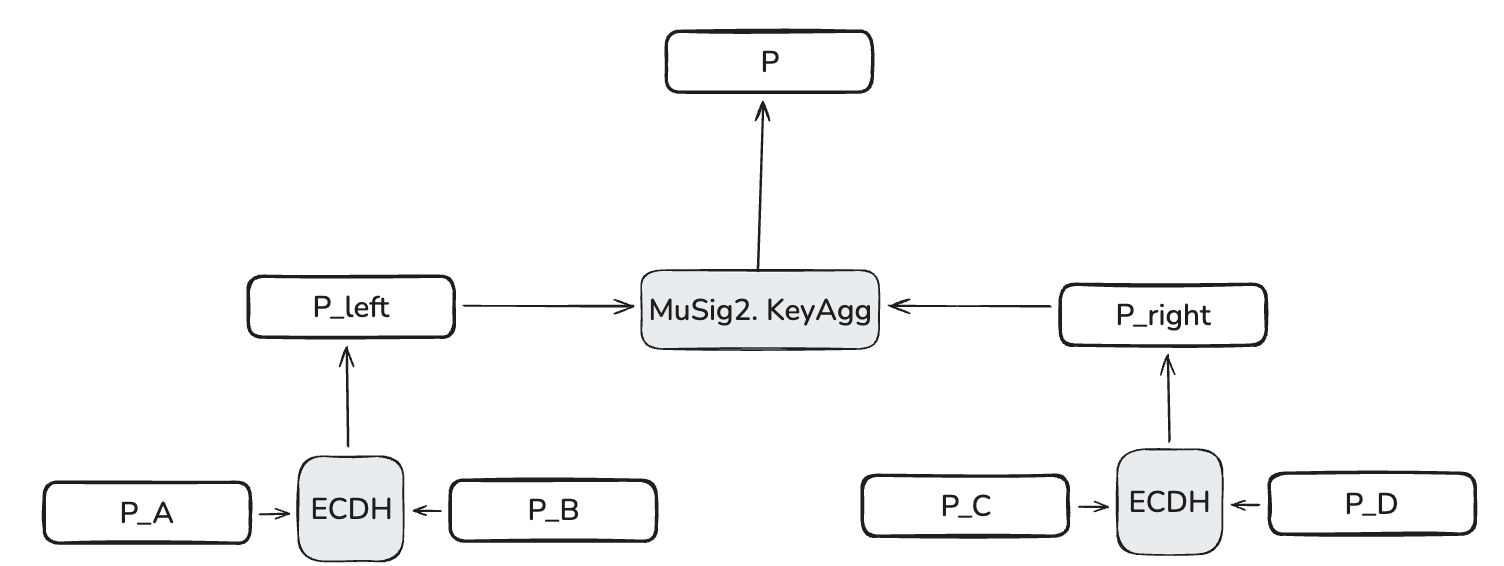
The verification key P is not a MuSig2 aggregation of all four parties. Instead, it’s a MuSig2 aggregation of P_left and P_right, where:
P_left = hash(ECDH(P_A, P_B)) * G

P_right = hash(ECDH(P_C, P_D)) * G
so P = MuSig2_KeyAgg(P_left, P_right).
To produce a valid under P signature, we need two parties who can access ECDH(P_A, P_B) and ECDH(P_C, P_D), respectively. Either A or B can compute the left ECDH (using their private key with the other’s public key), and either C or D can compute the right one. So, the set \{B,D\} can produce a valid signature, but \{A,B\} cannot because they both belong to the same P_left branch, leaving the right branch unsatisfied.
In the code example, Alice and Carol are the active signers, but this is just one of the four valid coalitions. Bob and Dave (or any other valid pair) can sign in exactly the same way.