You raise some quite interesting points!
Since you are talking about neighborhoods, do you think that the gossip graph is partitioned? I think that three random gossip syncers should be enough that there is only a single partition, though that assumes that every node works reliably.
Concerning the topic of “node liveness”, I can provide some additional numbers from a similar measurement, compared to yours, that I did a few months ago. While the results generally align with yours, my gossip observer also connected to Tor nodes and we let it run for longer (10 days continuously).
Overall, the gossip observer had an average of 4,195 peers out of 16,626 peers in the channel graph (Aug. 16, 2025). Also, we find that 4,859 nodes created at least one new gossip message during that time.
Looking at a larger timeframe of 55 days, we find that 7,579 were reachable at least once, and we made connection attempts to 13,165 nodes. The latter number is smaller than the number of nodes in the channel graph, since 5,607 nodes are private nodes in the channel graph with no socket addresses advertised.
Still, even when ignoring the private nodes, I find that it is not ideal that there are nodes in the network that are not reachable, and it raises the question, whether they are able to process payments. That number of 4,859 nodes that recently created a new gossip message also was unexpected for me. For a typical channel, I find that they typically create a new channel update at least every 24 hours.
Another related point to your goal minimizing bandwidth: I found that there is a small minority of nodes that are very “chatty”. Those frequently create redundant channel updates or node announcements, that differ only in their timestamp and signature fields. In once case, there is a node creating a new node announcement every 30 sec.
What exactly do you mean by “different positions” in the P2P network? Is that just a different selection of gossip syncers?
To give you another idea of experimentation: By using a special gossip_timestamp_filter message, you could request the entire channel graph from each node and then check, which information is missing.
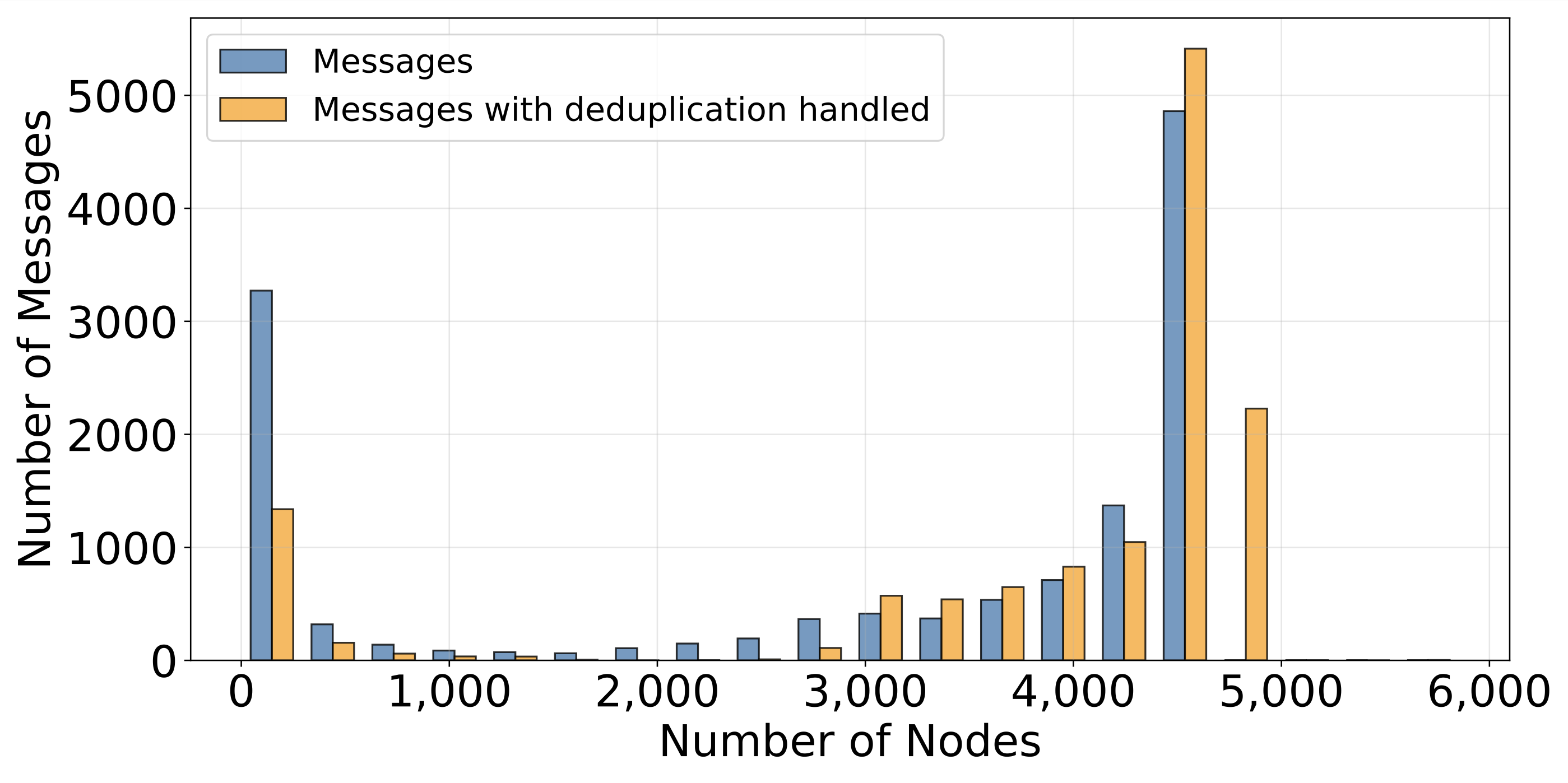
Looking forward to your investigation! I can also share that analysis based on my dataset (below), where there are only two peaks: One around 0 and the other one around the number of average peers that the node had. Though I did not include all messages received in the results, but made two methodological adjustments:
In the first plot labeled “Messages”, I already excluded messages that were historical. That is, when before starting the measurement, I first let the monitor synchronize its channel graph with the other nodes. When starting the actual measurement, I only include those messages that the node has not seen before. Since there are some nodes, sending their entire channel graph for new connection, it skews the results.
Another influence I looked at (plotted as “with deduplication”) is the staggered broadcast mechanism, where a node shall only forward a gossip message with the greatest known timestamp field. As this is one mechanism, where messages could be dropped, I changed the methodology to consider a node “receiving” a message when forwarding message m, or any of its successors m’ (where timestamp field of m’ is greater than that of m) to the gossip observer node. That further changes the results to what would be expected from the network: That every one of the ~4,500 connected nodes received each message. Though I cannot explain why there are so many messages in the 0–500 node range on the left that, apparently, starve.