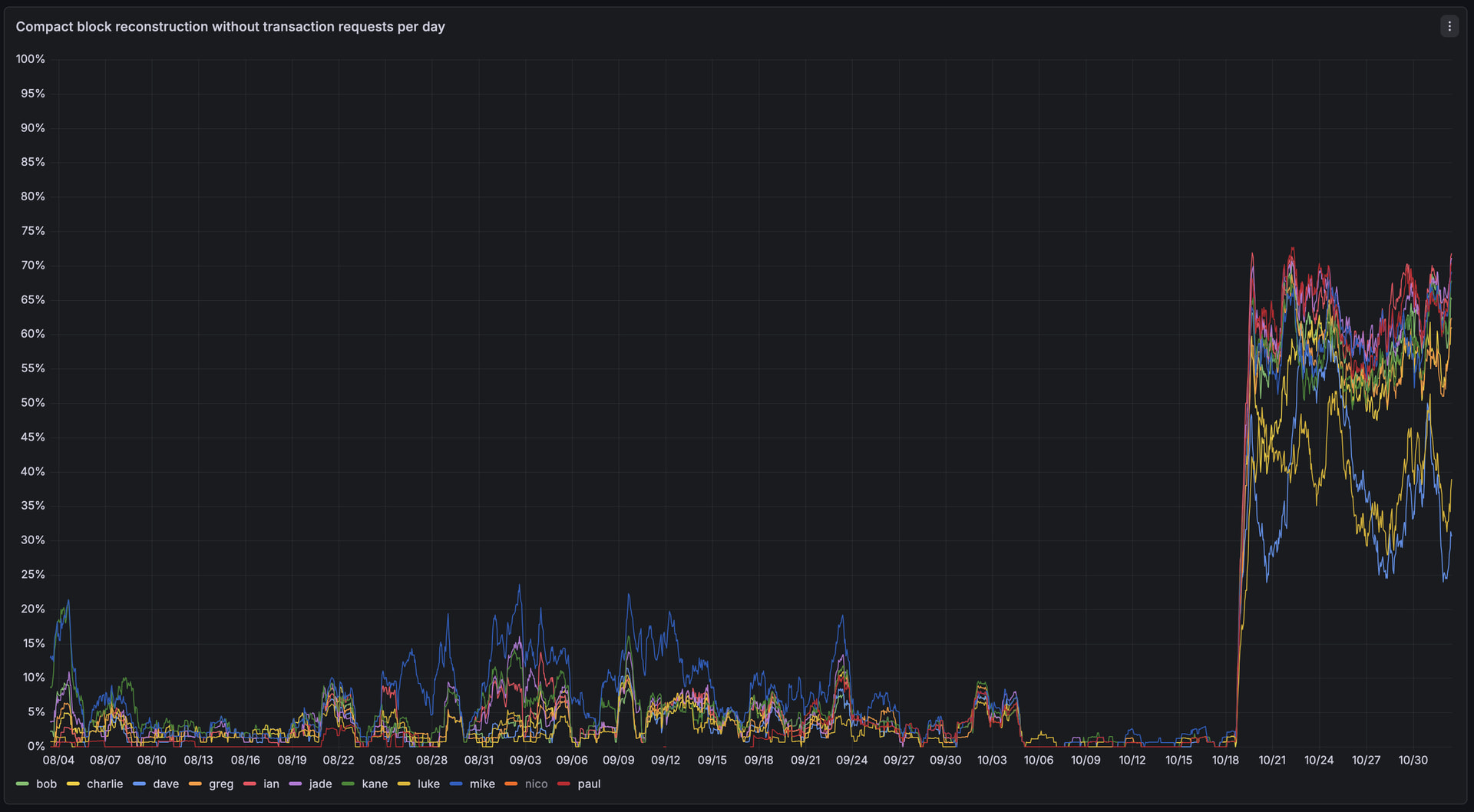
Someone wanted to get their uncommon-goods rune mints mined as cheap as possible. The cheapest way of having a transaction with one OP_RETURN for the mint (only one OP_RETURN is allowed per runestone mint) is to have a transaction with a P2A input and a P2A and OP_RETURN output (example). This is about 100vB and costs 10sat per mint at 0.1sat/vbyte in fees. The person creating these 100vB transactions chains them in row. These chains are pushed out to nodes on the network as unsolicited transactions (someone is just sending tx P2P messages, no inv → getdata round trip). Additionally, since P2A are anyone-can-spend, there seems to be someone with the UA /p2aburn:1.0/ burning these outputs to avoid the other person from minting these runes (example).
I suspect unsolicited pushing of long chains of transactions and someone burning (replacing) them as soon as they learn about them is causing a lot of the differences between mempools.
This all stopped on 2026-10-18. No more unsolicited chains of transactions being pushed. Reconstruction rates improved on the same day.
The most interesting part is the evaluation on section 7. They spawn 20 nodes on mainnet, half are considered sender nodes and the other half receiver nodes. “Importantly, receiver nodes were exclusively connected to their respective sender nodes to ensure they received the correct variant of the compact block relay. This design ensures fairness and consistency in evaluating relay performance across the network. In addition, all participating nodes were directly connected to the main Bitcoin mainnet. This ensured that our observations mirrored real-world conditions.”
A different paper (https://onlinelibrary.wiley.com/doi/10.1002/nem.2262 - gated by a paywall, DM me to get a copy) proposes to prioritize in the prefilledtxn field txs high higher fee, higher size, and less time siting in the local mempool. As we would expect, the authors find that prefilling the most recently received mempool txs substantially reduces the probability of needing getblocktxn, whereas prioritizing by transaction fee or size produces little improvement.
The methodologies are quite different and hard to compare directly, but it feels to me that prefilling based on previous compact blocks misses is a pretty good heuristic.