Other posts here have explored some of the bleeding-edge of lattice-based crypto: Post-Quantum HD-Wallets, Silent Payments, Key Aggregation, and Threshold Signatures
…But even at their best, lattice crypto schemes require several kilobytes of key+sig. Isogeny crypto is much more compact at less than 300 bytes of key+sig, does not accumulate errors, and can be used to do much of the same stuff.
I published this article just yesterday after spending the last few months researching isogenies. I’m still learning, so there may be some inaccuracies, it’s a difficult subject. I gave my best shot at making it approachable to bitcoin engineers who are already familiar with classical ECC.
Here’s a short version to give you a taste.
- Isogenies are functions that map points between different elliptic curves.
- Endomorphisms are isogenies that map points on a curve to itself, e.g. scalar multiplication is an endomorphism.
- Given two curves E_1 and E_2, we believe it is a hard problem to find an isogeny between them. This is called the “supersingular isogeny path problem” (SIPP).
- For every elliptic curve E there exists a mathematical object called the “endomorphism ring” of E, denoted \text{End}(E), which is the ring of all endomorphisms on E.
- Finding \text{End}(E) given only E is a hard problem, called the “endomorphism ring problem” (ERP).
- Some supersingular elliptic curves have well-known and friendly endomorphism rings. One such curve is E_0: y^2 = x^3 + x
- The SIPP has been proven equivalent to the ERP. Namely:
- Given curves E_1 and E_2 and their endomorphism rings \text{End}(E_1), \text{End}(E_2), we can efficiently compute an isogeny \varphi : E_1 \rightarrow E_2 (or E_2 \rightarrow E_1).
- Given curves E_1 and E_2, one endomorphism ring \text{End}(E_1) and an isogeny \varphi : E_1 \rightarrow E_2, we can efficiently compute the endomorphism ring \text{End}(E_2).
For cryptography, we typically generate a secret isogeny \varphi : E_0 \rightarrow E, and use our knowledge of \text{End}(E_0) to compute \text{End}(E). Our secret key is either \varphi or equivalently \text{End}(E).
Now we have some new powers which nobody else in the universe, hopefully even quantum-enabled attackers, can do:
- if given an isogeny \phi_1: E \rightarrow E', we can efficiently compute an isogeny \psi_1: E_0 \rightarrow E'
- if given an isogeny \phi_2: E_0 \rightarrow E', we can efficiently compute an isogeny \psi_2: E \rightarrow E'
We can use these abilities to instantiate signature schemes - see this section of the article. But mainly i want to show you how, given these simple rules, we get unhardened BIP32 key derivation.
All we need to do is generate a pseudorandom isogeny \psi: E \rightarrow E' which maps the public key to some new uniformly-random curve E'. This has been done before by existing schemes in a different context (e.g. producing challenge isogenies in SQIsign). The keyholder can recompute \psi and then use their knowledge of \text{End}(E) to find \text{End}(E'), and voila, they’ve updated their secret key. If needed the keyholder can use the publicly-known constant \text{End}(E_0) to find an updated secret isogeny \varphi' : E_0 \rightarrow E'.
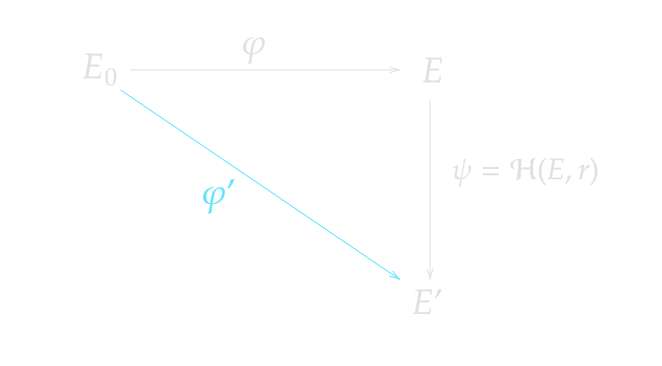
This same approach can be reused to recreate silent payments and taproot-style key tweaking (commitment inside a pubkey).
Multisignature isogeny schemes that can compete with SQIsign and PRISM for compactness are unfortunately still lacking, but I hope that by drawing attention to this topic, I can convince more bitcoin devs to start researching this subject and contribute to it the same way we’ve contributed to multisignature schemes in the domain of classical ECC.
 . But I’m curious how much maps over, since obviously I don’t know much of anything about this field: