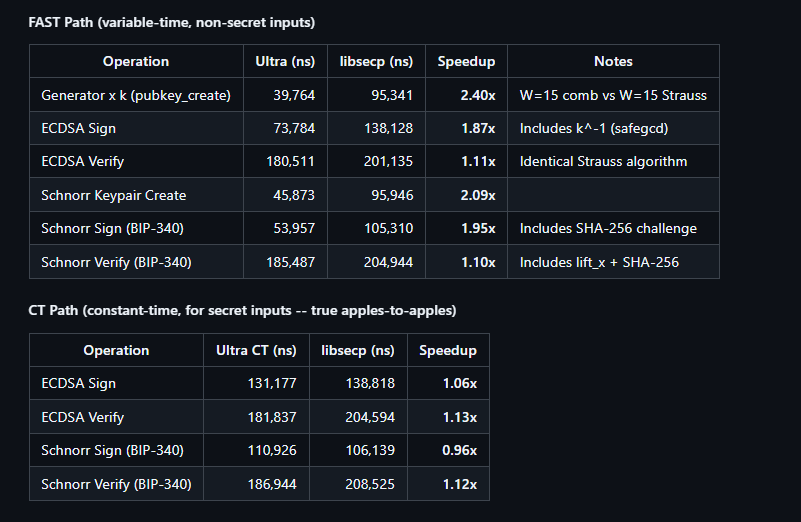
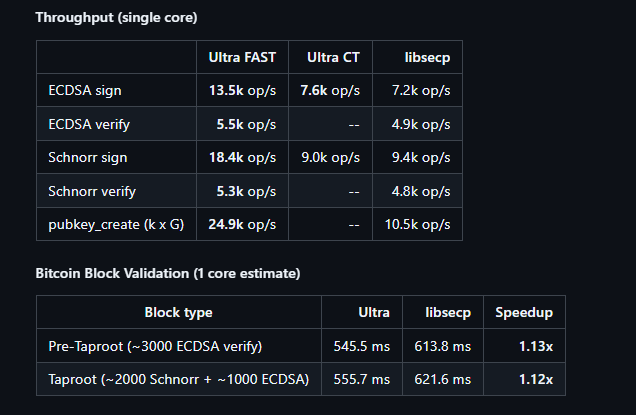
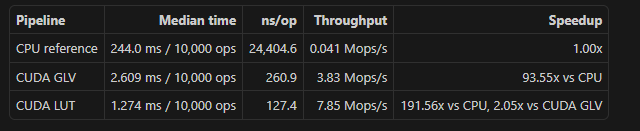
Introduction Hello everyone. I’ve been developing a high-throughput implementation called UltrafastSecp256k1. The project, which was open-sourced on February 11th, 2026, started as an exploration of how modern hardware features (SHA-NI, AVX2, ARM64 Assembly) can be leveraged to push the limits of ECC performance across diverse platforms—from high-end x86 servers to resource-constrained IoT devices like ESP32-S3 and RISC-V boards.
The goal is to create a highly portable, constant-time, and branchless library that is accessible through multiple language bindings (12+ languages including Rust, Go, Swift, and Dart). I am reaching out to this community for a technical audit, feedback on the cryptographic primitives, and suggestions on our constant-time implementation.
Architecture & Core Optimizations
The library is built on a “Zero-Allocation” hot-path contract, ensuring no heap overhead during critical operations. Key technical pillars include:
- Field Representation: We transitioned to a field representation for Point internals, enabling
__int128lazy reduction across constant-time (CT) operations. - Constant-Time Field Inversion: Implemented using the SafeGCD (divsteps) algorithm, specifically optimized for different architectures (e.g., divsteps for robustness).
- Scalar Multiplication: Leverages GLV Endomorphism via -decomposition combined with interleaved double-and-add, significantly reducing the cycle count for .
- Hardware Acceleration: We use SHA-NI (Intel/AMD SHA Extensions) for high-speed hashing dispatching and AVX2 CT table lookups for secure, constant-time scans.
- I-Cache Efficiency: We utilize
noinlineon large functions likejac52_add_mixed_inplaceto prevent instruction cache pollution, resulting in a ~59% reduction in I-cache misses.
Platform-Specific Implementation & Benchmarks
We have focused on making the library performant where it’s needed most:
- x86_64: Utilizing Comb precomputation tables (teeth=6, blocks=43) to optimize operations, achieving significant speedups over standard implementations.
- ARM64 (Android/Linux): Hand-tuned multiply/square bypasses directly calling assembly, optimized for Cortex-A76 and newer cores.
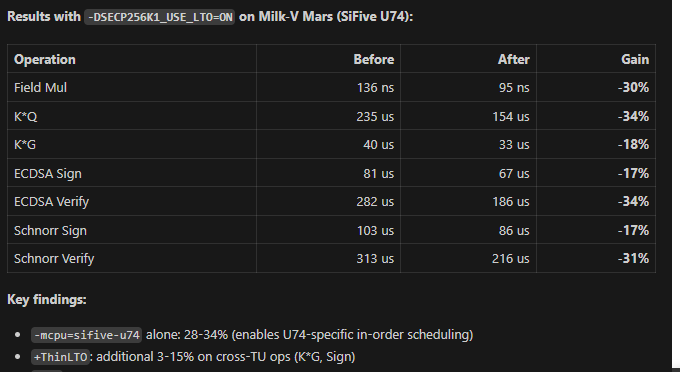
- Embedded & Emerging: Current support for ESP32-S3 and upcoming optimizations for RISC-V (Milk-V Mars).
Current State (v3.10.x): The library currently passes over 12,000 consistency tests across x86 and ARM64 platforms. The ecosystem includes full bindings for NPM (Node.js/React Native) and NuGet (.NET), making it ready for high-level integration.
Request for Review & Technical Discussion
I am specifically looking for feedback on:
- Constant-Time Integrity: Review of our assembly bypasses for potential side-channel leaks.
- Algorithm Selection: Evaluation of our H-Product Serial Inversion and SafeGCD implementation details.
- Branchless Logic: Suggestions for further removing branches in the point-normalization and signing flows to improve security.
The project is fully open-source, and I believe that peer review from the Delving Bitcoin community is vital to ensure this tool remains both fast and secure for the wider ecosystem.
GitHub Repository: https://github.com/shrec/UltrafastSecp256k1
Technical Changelog:https://github.com/shrec/UltrafastSecp256k1/blob/c649f6dfd80b1611b17f606206b156e3c2e6a058/CHANGELOG.md