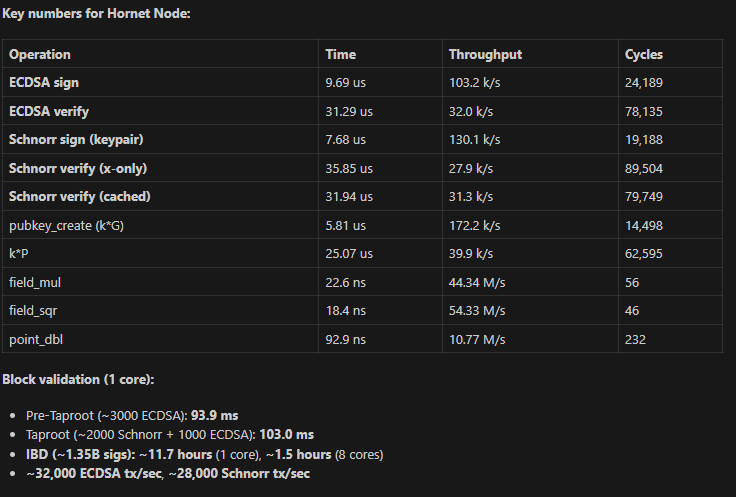
This sounds pretty cool, and I’d be interested to see how it performs in Hornet Node’s IBD. Do you have any benchmark results, e.g. how many signature verifications per second?
Links here in case you missed it:
https://delvingbitcoin.org/t/hornet-utxo-1-a-custom-constant-time-highly-parallel-utxo-database/2201
Mark “Murch” Erhardt, Gustavo Flores Echaiz, and Mike Schmidt are joined by Toby Sharp, Chris Hyunhum Cho, Jonas Nick, and Antoine Poinsot to discuss Newsletter #391.
1 Like
shrec
February 26, 2026, 8:14am
3
hello please join to our Discord channel and we can discuss all detail you are interested. yes i have many banchmarks on different devices and platforms you also can see them on git repo but i have more new improovments that not released yet will be today or max in 2 days working on self code auditing to check and test all edge cases
1 Like
shrec
February 26, 2026, 8:41am
5
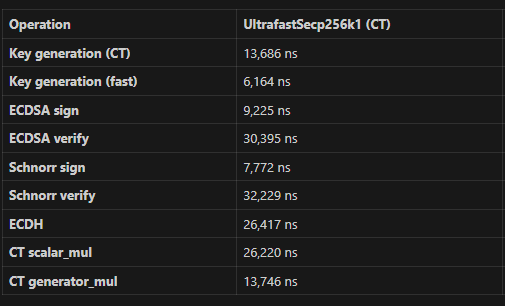
4.88 M ECDSA signs/s * 2.44 M ECDSA verifies/s * 3.66 M Schnorr signs/s * 2.82 M Schnorr verifies/s – single GPU (RTX 5060 Ti) this is GPU benchmark
1 Like
shrec
February 26, 2026, 5:00pm
6
Clang 21.1.0, i7-11700, single core, pinned:
1 Like
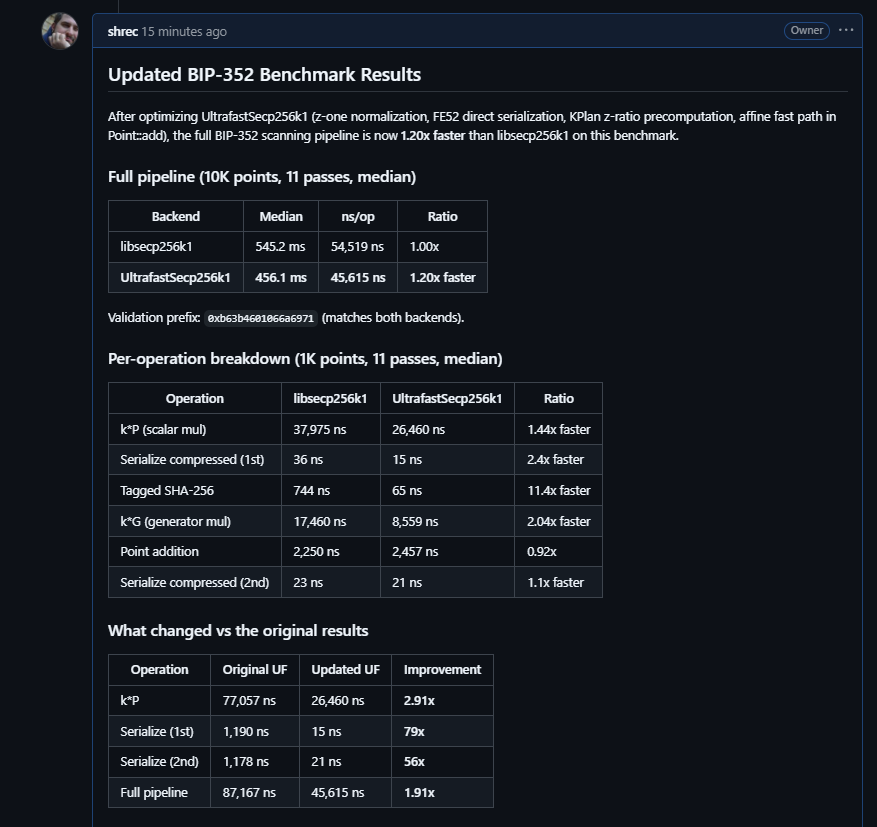
I think it would be helpful and meaningful if you showed like-for-like comparative performance between your optimized library and the baseline libsecp256k1 implementation used by Bitcoin Core for instance. A useful metric would be number of ECDSA verifications per second, and then some discussion of where performance gains were made and where the remaining bottlenecks are for bandwidth.
1 Like
Nice that you have both CPU and GPU versions. Is the GPU version using CUDA, OpenCL, or some other platform, and is it vendor-specific?
shrec
March 2, 2026, 3:06pm
9
i have all platform support CUD and OpenCL also Apple Metal too
shrec
March 5, 2026, 7:08pm
10
Benchmark: UltrafastSecp256k1 vs libsecp256k1 on BIP-352 scanning pipeline
opened 02:24PM - 04 Mar 26 UTC
# CPU Performance Report: UltrafastSecp256k1 vs libsecp256k1 in BIP-352 Silent P… ayments Scanning
## Summary
I integrated UltrafastSecp256k1 (v3.16.0) into a DuckDB extension for BIP-352 Silent Payments scanning and benchmarked it against an equivalent extension using bitcoin-core/secp256k1. In this real-world workload, **UltrafastSecp256k1 is 1.7-1.9x slower than libsecp256k1** on x86-64 Linux, contradicting the project's claimed 1.47x overall speedup (CHANGELOG v3.15.0, `bench_apple_to_apple`).
## Context
[Frigate](https://github.com/nickg/frigate) is an Electrum server for Bitcoin Silent Payments (BIP-352). It uses DuckDB with custom extensions to scan transaction tweaks against a wallet's keys. I maintain three DuckDB extensions:
- [**duckdb-secp256k1-extension**](https://github.com/sparrowwallet/duckdb-secp256k1-extension) — CPU scanning via libsecp256k1's C API
- [**duckdb-ufsecp-extension**](https://github.com/sparrowwallet/duckdb-ufsecp-extension) — CPU scanning via UltrafastSecp256k1, plus GPU-accelerated scanning via CUDA
- [**duckdb-cudasp-extension**](https://github.com/sparrowwallet/duckdb-cudasp-extension) — GPU scanning via a separate CUDA library
I implemented a `scan_silent_payments` scalar function in the ufsecp extension (on the [`cpu_scalar_fun`](https://github.com/sparrowwallet/duckdb-ufsecp-extension/tree/cpu_scalar_fun) branch) that mirrors the secp256k1 extension's function exactly in signature and behavior, to allow a direct performance comparison.
## BIP-352 Scanning Pipeline (per row)
Each row in the scan performs these operations:
1. **EC scalar multiply** (fixed K, variable Q): `shared_secret = tweak_point * scan_private_key`
2. **Serialize** to 33-byte compressed SEC1
3. **Tagged SHA-256**: `hash = tagged_sha256("BIP0352/SharedSecret", serialized || 0x00000000)`
4. **Generator multiply**: `output_point = hash * G`
5. **EC point addition**: `candidate = spend_pubkey + output_point`
6. **Match check**: compare upper 64 bits of candidate x-coordinate against outputs list
7. **Label iteration**: for each label L, compute `candidate + L` and re-check
The bottleneck is the two scalar multiplications (steps 1 and 4).
## UltrafastSecp256k1 Optimizations Used
The ufsecp implementation uses several UltrafastSecp256k1-specific optimizations not available in the libsecp256k1 version:
- **KPlan precomputation**: The scan_private_key is constant across all rows. I precompute a `KPlan` (GLV decomposition + wNAF encoding) once and reuse it via `scalar_mul_with_plan()` for every row. This avoids repeated GLV decomposition.
- **Tagged hash midstate caching**: The `"BIP0352/SharedSecret"` tag midstate is computed once and reused via `cached_tagged_hash()`.
- **Static caching**: Both the KPlan and midstate are cached in static variables keyed on the scan_private_key, so they persist across DuckDB query invocations.
Despite these optimizations, the ufsecp version is significantly slower.
## Benchmark Results
**Hardware**: x86-64 Linux (same machine for all tests)
**Workload**: BIP-352 Silent Payments scanning over Frigate's DuckDB tweak database
**Both extensions produce identical results** (verified on both datasets)
### Testnet4 (~56,000 rows)
| Extension | Backend | Wall Time |
|-----------|---------|-----------|
| duckdb-secp256k1-extension | libsecp256k1 (scalar fn) | **24.2s** |
| duckdb-ufsecp-extension | UltrafastSecp256k1 `scan_silent_payments` (scalar fn) | 45.3s |
| duckdb-ufsecp-extension | UltrafastSecp256k1 `ufsecp_scan` (table fn, batched) | 50.7s |
| duckdb-ufsecp-extension | CUDA GPU `ufsecp_scan` | 1.8s |
**UltrafastSecp256k1 scalar function: 1.87x slower than libsecp256k1**
### Mainnet (~880,000 rows)
| Extension | Backend | Wall Time |
|-----------|---------|-----------|
| duckdb-secp256k1-extension | libsecp256k1 (scalar fn) | **378.3s** |
| duckdb-ufsecp-extension | UltrafastSecp256k1 `scan_silent_payments` (scalar fn) | 647.7s |
| duckdb-ufsecp-extension | UltrafastSecp256k1 `ufsecp_scan` (table fn, batched) | 610.6s |
**UltrafastSecp256k1 scalar function: 1.71x slower than libsecp256k1**
### Note on the batched table function
The `ufsecp_scan` table function uses additional batch optimizations (Montgomery batch Z-inversion, batch affine addition) on top of the same UltrafastSecp256k1 primitives. Even with these, it is still 1.6x slower than libsecp256k1's non-batched scalar function on mainnet.
## Analysis
### Per-row cost breakdown
The BIP-352 pipeline is dominated by two scalar multiplications per row:
| Operation | libsecp256k1 (estimated) | UltrafastSecp256k1 (estimated) |
|-----------|-------------------------|-------------------------------|
| EC scalar multiply (fixed K, variable Q) | ~15-20 us | ~25 us (with KPlan) |
| Generator multiply (k*G) | ~12-15 us | ~6 us (precomputed) |
| Serialize compressed | ~3 us | ~3 us |
| Tagged SHA-256 | ~0.5 us | ~0.3 us (midstate cached) |
| Point addition | ~1 us | ~0.5 us |
| **Total** | **~32-40 us/row** | **~35-45 us/row** |
The generator multiply is faster in UltrafastSecp256k1, but the arbitrary-point scalar multiply (the dominant operation) is significantly slower.
### Why the `bench_apple_to_apple` results don't translate
The project's own `bench_apple_to_apple` (CHANGELOG v3.15.0) claims "7 FASTER, 5 EQUAL, 0 SLOWER (geometric mean 0.68x = UF 1.47x faster overall)" against libsecp256k1 v0.6.0 on 13 operations. However:
1. **The benchmarks primarily measure signing and verification paths**, not the raw scalar multiplication that dominates BIP-352 scanning. The project's own `bench_hornet` report (Windows, i7-11700, Clang 21.1.0) shows:
- Generator multiply (k*G): 5,976 ns (UF) vs 15,402 ns (libsecp) — **2.58x faster** (UF wins)
- ECDSA Verify: 30,743 ns (UF) vs 25,423 ns (libsecp) — **0.83x, libsecp wins**
2. **The 1.47x claim uses geometric mean across operations with very different weights.** Generator multiply shows a large speedup (2.58x) but arbitrary-point scalar multiply — which is the bottleneck in BIP-352 scanning — is not separately benchmarked in the apple-to-apple suite.
3. **libsecp256k1 uses hand-tuned x86_64 assembly** (5x52-bit limbs with inline asm, carefully scheduled `mulx`/`adcx`/`adox` instructions). UltrafastSecp256k1 uses portable C++20 which, while producing good code, does not match hand-written assembly for field arithmetic throughput on x86-64. Note that both libraries use the FAST (variable-time) path in this workload — the scan key multiplies public tweak points, so constant-time guarantees are not required.
4. **The bench_hornet v3.16.1 comparison** (4 platforms, libsecp256k1 v0.7.2, 6-op suite) confirms the pattern: UltrafastSecp256k1 wins on generator multiply and signing, but loses on verify operations that are dominated by arbitrary-point scalar multiplication — the same operation that dominates BIP-352 scanning.
## Recommendation
The README's title claim "Fastest Open-Source secp256k1 Library" and the CHANGELOG's "1.47x faster overall" should be qualified:
1. **The claims don't hold for workloads dominated by arbitrary-point scalar multiplication on x86-64.** Generator multiply (k*G) is genuinely faster in UltrafastSecp256k1, but k*P (arbitrary point) appears significantly slower, and k*P dominates in many real-world protocols.
3. **The GPU backends are genuinely impressive and unique** — no other open-source library provides secp256k1 ECDSA/Schnorr on CUDA/Metal/OpenCL. The GPU performance (1.8s vs 24.2s on testnet4) is the real differentiator.
4. Consider adding a benchmark for **arbitrary-point scalar multiplication (k*P)** to the apple-to-apple suite, as this is the dominant operation in many real-world protocols (ECDH, BIP-352 scanning, key tweaking).
## Environment
- **OS**: Linux 6.17.0-14-generic (x86-64)
- **UltrafastSecp256k1**: v3.16.0 (submodule in duckdb-ufsecp-extension)
- **libsecp256k1**: latest master (submodule in duckdb-secp256k1-extension)
- **DuckDB**: v1.4.4
- **Compiler**: System default (GCC/Clang via CMake)
- **Build**: Release mode, `-O3`